

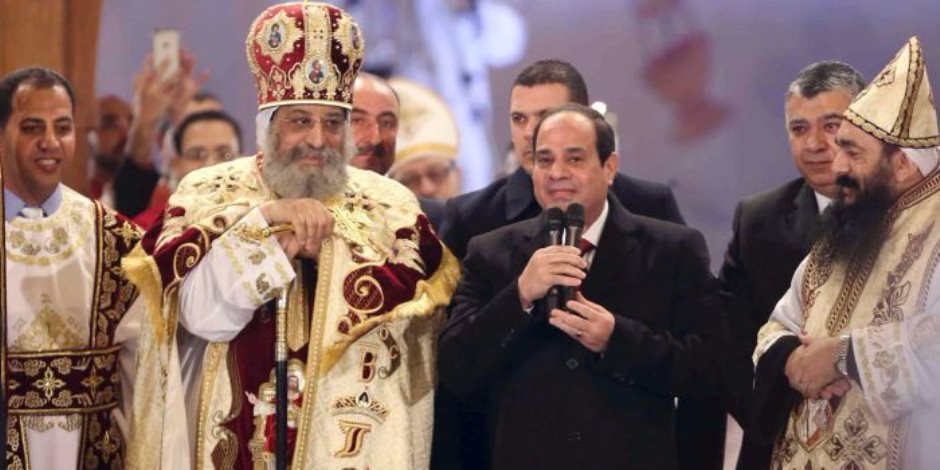
Egyptian president Abdel-Fattah el-Sisi surprised the copts in Egypt turned up at the Coptic Christmas Eve service in Cairo’s St Mark’s cathedral, in 2015 as a first president visits the cathedral on the Christmas eve, Although it was a symbolic sign but Egyptian Christian consider it as a new era.
Since elected as a president of Egypt in 2014, Mr. Sisi called to tolerance and Coexistence between all Egyptians. However calls aren’t
enough. As the presidential elections after few weeks this month,
copts may find a lot of reasons for reelecting Mr. Sisi.
First, president Sisi kept his promise as the engineering unit of the
Armed Forces immediately started cooperating with the Coptic church to
restore Christian properties damaged in the aftermath of Islamist
president Mohamed Morsi’s ouster in 2013.
On August 14, immediately following the dispersal of the Muslim
Brotherhood sit-ins in Cairo, crowds of Muslim Brotherhood followers
attacked at least 42 churches, burning or damaging 37, as well as
dozens of other Christian religious institutions in the governorates
of Minya, Asyut, Fayum, Giza, Suez, Sohag, Bani Suef, and North Sinai.
By the end of 2016, the government had nearly completed rebuilding and restoring 78 churches and other Christian sites damaged or destroyed by mob violence.
Second, After 160 years of tight restrictions on building churches in
Egypt finally the parliament passed a law in 2016 for restoring and
building churches without. Before that, it was very hard to build
church as church building or restoration were left to the discretion
of the [Muslim] local rulers who were more often than not inclined to
subdue the Copts. Moreover, building of new churches has also been at
the centre of sectarian strife.
The new law also includes provisions to legalize existing unlicensed
churches and rescinds preconditions established in the 1930s. It
stipulates that, in the event a request to license an existing
building used as a church is refused, the use of the building to
conduct church services and rites may not be prevented. Under the new
law, the size of new churches depends on a government determination of
the “number and need” of Christians in the area. New churches must
also meet land registration and building codes not required for
mosques.
Lately, Egypt’s Cabinet approved recommendations made by a review
committee to confirm the legal status of 53 churches and associated
service buildings out of 3,730 requests submitted.
Third, Hours after masked gunmen attacked a group of Coptic
Christians traveling to a monastery in southern Egypt, killing 29 and
wounding 24, in May 2017, President Abdel Fattah al-Sisi said he had
ordered strikes against terrorist camps in libya, declaring in a televised address that states that sponsored terrorism would be
punished. following slaughtering 20 Coptic Christian when ISIS in Libya released a video claiming beheading the construction workers that they had kidnapped in the city of Sirte, Libya on February 15, 2015, el Sisi announced a seven-day period of national mourning and called for an urgent meeting with the country's top security body. In a televised address, al-Sisi declared his country reserved the right for retaliation. On February 16 at dawn Egyptian military conducted airstrikes on ISIL facilities in Libya. The airstrikes targeted ISIL training locations and weapons stockpiles. Those strict and swift action in retaliating for the Egyptian citizens made Christians in Egypt feel for the first time that their life matters after long decades of discrimination and marginalization.
Moreover this strengthened the image of Mr. Sisi as a protector and
president of all Egyptians.
Fourth, Mr. sisi’s calls for "religious revolution," and purging
religious discourse of extremism, sent an indirect message to
Christians about a new environment of tolerance. Many Copts regard
Sisi as the figure who prevented Egypt from falling under the
domination of the Brotherhood, seen by them as anti-Christian, and are
grateful for the police protection now provided for churches.
However last indicators which might give Copts in Egypt hope after
years of fear, especially during year of Muslim brotherhood rule,
can’t hide a dark side:
Beside some hard conditions that the new law for building the
church imposes on building the new churches, there is a problem
relating the rule of law in many places in Egypt where the hardliners
refuse building new churches. There are numerous incidents of
sectarian mob violence against Coptic Christians, including attacks
resulting from Muslim opposition to the presence of churches in their
communities.
On July 17,2016 assailants armed with bats and knives attacked the
families of two Coptic priests in their homes in Tahna El-Gabal
village in Minya, killing one family member and injuring three,
including an elderly man, according to an official statement by the
local Coptic Orthodox bishopric. a group of 100 villagers had attacked
the victims in response to a rumor that the community was building a
new church in the village.
On November 24, 2016 a mob of Muslim residents in Al-Naghameesh
village in Sohag Governorate burned a Christian-owned guesthouse that
was being used for worship services. Christians had applied to have
the building registered as a church, under the new law on licensing
churches. Four Christians were injured in the attack, and the mob also
looted three Christian-owned stores and damaged or destroyed 10
Christian-owned properties, consisting of nine homes and a garage.
On June 29, 2016 Muslims in Kom al-Loufi village in Minya Governorate
attacked a Christian-owned home after rumors spread that he intended
to use the new house he was building as a church. The assailants set
fire to the home and to three other homes owned by the Christian
resident’s brothers. Two days earlier, security officers had forced
construction workers to stop work at the house, reportedly due to
tensions between Christians and Muslims in the community. Following
the attack, police arrested 19 suspects on charges of “creating
chaos,” arson, and resisting authorities. All were released on bail
within a month. An MP told the press that victims had received death
threats if they did not agree to customary reconciliation and withdraw
their complaints. The victims refused, insisting that the perpetrators
be prosecuted in court.
Last examples of incidents highlight a serious problem relating to
“rule of law” especially in upper Egypt where customary
reconciliation, which is common, give the perpetrators impunity. But
the most stark example of this impunity is the case of Souad thabet,
who doesn’t find justice till now.
On May 20, 2016 in the village of El-Karm in Minya Province,
approximately 300 Muslim villagers stripped naked an elderly Coptic
Christian woman, Souad Thabet, and paraded her through the streets
after a rumor spread that her son was having an affair with a married
Muslim woman. They also attacked her daughter in law and stripped her
of her clothes, dragged on the stairs and threw her in front of her
children. Also they beat the children and tried to put them in the
fire, but a neighbor prevented them and begged not to do so with
children.
The villagers also set fire to the woman’s house, along with three
other houses owned by Coptic Christians unrelated to the woman, looted
two others, and injured two Christians. The fire spread to several
neighboring houses. Police did not arrive until more than an hour
after the incidents, according to press reports.
Thabet told me in an interview that she and her husband had filed a
formal police complaint the day before the attacks about receiving
threats, stating that they expected an attack the following day, but
police had not responded. In the days following the incidents, police
arrested 16 Muslim suspects and several Christians whom they accused
of setting fire to the neighboring houses that had caught fire.
Immediately after the attack, President Sisi announced that the
perpetrators would be prosecuted to the fullest extent of the law. By
July 13, all suspects had been released on bail pending criminal
investigations. Till now Thabet didn’t get justice and no one
prosecuted for attacking her.
Still there is a gulf between statements from the national leadership
regarding the Christian community and actions at a local level. This
needs big effort from the president who speaks about Christians with a
lot of respect and sympathy. He may need a task force works on
societal change in upper Egypt through cooperation with the civil
society and youth.