



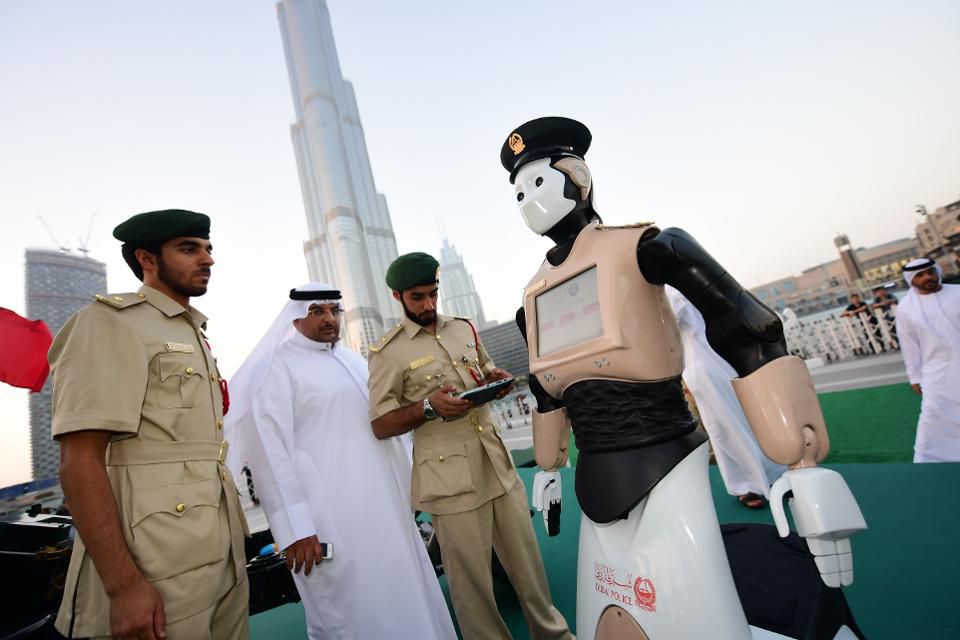
Last October, presumably to promote itself as a place to develop Artificial Intelligence (AI), Saudi Arabia became the first country to grant citizenship to a robot. But it isn't the only Middle East country making strides in AI.
The UAE, which plans to have robot cops and autonomous vehicles on its roads and in its skies sooner rather than later, appointed a State Minister for AI -- Omar bin Sultan Al Olama. “In 10 years we will be the capital of AI in service and government. I also think we will be a hub for AI in the region,” Al Olama said.
As tech companies, led by Google and Amazon, are beginning to center their business models around AI, it’s no surprise that the oil-rich Middle East -- which is investing in technologies that are future-focused -- want to be at the forefront of this development. While technologies like blockchaincontinue to see an increase in application, AI is expected to take the lead among transformative technologies for enterprises. More so because of high-growth startup scenes in the region, where annual investment is fast approaching $1 billion, and governments prioritizing innovation.
“The tech revolution happening in the Middle East is fierce. The region is taking every opportunity to leapfrog its way in adopting AI technologies and trends,” says Sharif El-Badawi, partner at 500 Startups, a Silicon Valley venture capital firm investing in the Middle East. “We’re seeing machine learning become a part of a large swath of current startups and, to some degree, larger companies.”
Significant gainers
According to a PwC study, the potential contribution of AI to the global economy will peak to almost $16 trillion by 2030 and the Middle East is expected to accrue 2% of the total global benefits of AI in 2030. This is equivalent to $320 billion. The largest gains are expected to accrue to UAE where AI is expected to contribute close to 14% of its GDP, and Saudi Arabia with close to 13 % of GDP in 2030. The contribution of AI to the economies of these two countries are on par with economies in Southern Europe and developed Asia. The other most significant relative gainers in the region will be Bahrain, Kuwait, Oman and Qatar.
“The impact on productivity will be transformational and disruptive for a region like the Middle East which faces weak productivity levels,” says Richard Boxshall, senior economist at PwC Middle East. “The benefits [of adopting AI] will come through productivity gains -- augmenting employees and freeing them to do other higher value activities, consumer benefits from product enhancement, greater personalization of goods and services, and time savings.”
BLOG COMMENTS POWERED BY DISQUS